

Have you ever used a mobile app or website that was so simple and intuitive that you completed your task without thinking twice? On the other hand, you may also have encountered websites that were confusing, slow, or difficult to navigate. The difference often comes down to UI (User Interface) and UX (User Experience) design. A UI UX Course helps learners understand how to create digital products that are not only visually appealing but also easy and enjoyable to use.
As businesses continue investing in websites, mobile applications, and digital platforms, the demand for UI and UX professionals has grown across industries. From banking and healthcare to education, e-commerce, travel, and entertainment, organizations recognise that a positive user experience can improve customer satisfaction, increase engagement, and strengthen brand loyalty.
Understanding the Difference Between UI and UX
Although UI and UX are often mentioned together, they focus on different aspects of digital product design.
User Interface (UI) deals with the visual elements that users interact with, including buttons, colours, typography, icons, layouts, and navigation menus. UI designers focus on creating interfaces that are attractive, consistent, and easy to understand.
User Experience (UX) focuses on how users interact with a product. UX designers study user behaviour, identify challenges, simplify workflows, and ensure that digital products help users achieve their goals with minimal effort.
A successful digital product combines both UI and UX to deliver a seamless experience.
What Does a UI UX Course Cover?
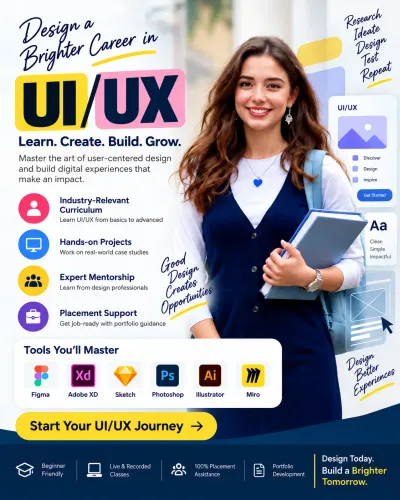
A structured UI UX Course introduces learners to the complete design process rather than only teaching design software.
Common topics include:
- Principles of User Interface Design
- User Experience Fundamentals
- Design Thinking
- User Research
- Wireframing
- Prototyping
- Information Architecture
- Visual Design Principles
- Responsive Design
- Accessibility Standards
- Usability Testing
- Design Systems
These subjects help learners understand how professional designers approach digital product development from concept to final implementation.
Why User-Centred Design Is Important
Modern businesses design products around users rather than technology alone.
Before creating a website or mobile application, designers often ask questions such as:
- Who will use this product?
- What problems are users trying to solve?
- Which features are most important?
- What obstacles might users face?
- How can navigation become simpler?
Answering these questions leads to products that are more useful, accessible, and effective.
Essential Skills Learners Develop
A UI UX Course focuses on developing both creative and analytical abilities.
Students commonly build skills in:
- User research
- Problem-solving
- Visual communication
- Wireframe creation
- Interactive prototyping
- Design consistency
- Typography selection
- Colour theory
- User journey mapping
- Collaboration with developers
These skills enable designers to contribute throughout the product development lifecycle.
Is Coding Required?
One common misconception is that every UI UX designer must know programming.
While basic knowledge of HTML and CSS can improve collaboration with developers, most UI UX professionals focus primarily on research, design, usability, and user behaviour. The emphasis is on creating effective user experiences rather than writing application code.
This makes UI UX an attractive career option for learners who enjoy creativity, design, psychology, and problem-solving.
Why Practical Projects Matter
Design is learned through observation and practice.
Working on real projects allows students to:
- Design websites and mobile applications.
- Create user personas.
- Build interactive prototypes.
- Conduct usability testing.
- Improve existing digital interfaces.
- Present design decisions confidently.
A portfolio containing practical design projects often becomes one of the most important assets during internships and job interviews.
Career Opportunities After a UI UX Course
As digital products continue expanding across industries, UI UX professionals can explore roles such as:
- UI Designer
- UX Designer
- Product Designer
- Interaction Designer
- Visual Designer
- User Researcher
- Experience Designer
- Design Consultant
Many professionals also work with software companies, startups, design agencies, fintech organizations, healthcare platforms, and educational technology companies.
Why UI UX Skills Are Becoming Popular in Gandhipuram
Gandhipuram is one of Coimbatore's busiest commercial and educational areas, attracting students, professionals, entrepreneurs, and technology enthusiasts. Its connectivity to educational institutions and business centres makes it a convenient location for learners seeking career-oriented technology education. As businesses across Coimbatore and Tamil Nadu continue investing in websites, mobile applications, and digital platforms, the demand for professionals who understand user-centred design continues to increase.
When selecting a UI UX Course, learners should look beyond software training. A quality program should include design thinking, portfolio development, usability testing, industry projects, mentor feedback, and exposure to modern design tools. Institutions such as Vinsup Skill Academy provide technology-focused learning programs that encourage practical application alongside conceptual understanding, helping learners prepare for evolving industry requirements.
UI and UX design are no longer limited to technology companies. Every organization that builds digital products benefits from professionals who can create intuitive, accessible, and engaging user experiences. Learning these principles provides a strong foundation for a career that combines creativity, research, technology, and human-centred problem-solving.