

Choosing an AI course is difficult when job titles, tools, and hiring expectations overlap. By the end, you will be able to distinguish the main career paths, identify the technical and mathematical depth each requires, and judge whether a course produces credible evidence of job readiness.
Key takeaways
- Target junior AI, data, automation, or application-development roles first.
- Build with Python, SQL, APIs, Git, cloud tools, and model-evaluation methods.
- Test retrieval, citations, latency, cost, safety, and failure cases before deployment.
- Use portfolio projects to prove measurable results, reproducible code, and clear technical decisions.
Which AI careers can this course realistically prepare you for?
A course can prepare you for several AI functions, but not equally. Your entry point depends on how much coding, mathematics, and production responsibility you can demonstrate—not on the job title alone.
| Role | Daily work | Education, coding and mathematics | Entry-level access |
|---|---|---|---|
| Prompt engineer | Designs prompts, tests outputs, and documents failure cases | Basic programming helps; limited mathematics; writing, evaluation, and domain knowledge matter | Accessible in support, content, or operations roles, but rarely a standalone first job |
| AI application developer | Connects models to APIs, databases, user interfaces, and business workflows | Python, SQL, Git, APIs, and debugging; practical statistics; a degree is helpful, not always essential | Realistic with strong projects showing working applications |
| Generative AI engineer | Builds RAG systems, manages embeddings, evaluates responses, and improves reliability | Solid Python, data structures, cloud, Docker, and model APIs; statistics and linear algebra support decisions | Junior roles exist, but require deployment evidence |
| Machine learning engineer | Trains, packages, serves, and monitors predictive models and pipelines | Deeper Python, SQL, software engineering, probability, statistics, and linear algebra; a technical degree is common | Harder entry point; classical machine-learning projects strengthen readiness |
| Data analyst or scientist | Cleans data, finds patterns, visualizes results, and supports decisions | SQL, pandas, visualization, statistics, and experimentation; coding depth varies | Often a clearer first step than “prompt engineer” |
A course is strongest when it teaches both generative AI and classical machine learning, then proves your ability to build and evaluate—not merely prompt—a usable system.
What technical stack turns AI knowledge into employable ability?
A job-ready stack connects data preparation, model training, and production delivery. Use notebook environments for experiments, NumPy for numerical arrays, pandas for tabular data, and SQL for querying real databases. Then use Git to track code, datasets, experiment notes, and changes.
| Layer | Tools | Employable ability |
|---|---|---|
| Data and classical ML | NumPy, pandas, SQL, scikit-learn | Clean data, prevent leakage with split-first pipelines, train models, and measure performance |
| Deep learning | PyTorch or TensorFlow | Build training loops, work with tensors, use GPUs, and understand loss, inference, and model checkpoints |
| Generative AI | transformer APIs, embeddings, vector databases | Create retrieval-augmented generation systems, manage context windows, and compare RAG with fine-tuning |
| Deployment | Docker and cloud platforms | Package dependencies, expose an API, monitor latency and cost, and ship a repeatable service |
Do not stop at a notebook that predicts well. A learner should turn the same project into a version-controlled repository with a README, environment file, tests, Docker configuration, and a cloud deployment. That process exposes problems hidden during experimentation.
The conceptual layer matters as much as the tools: understand tokens, transformer attention, embeddings, training versus inference, and why a model produces different results at different temperature settings. For RAG, evaluate retrieval recall and grounded answers rather than trusting fluent text.
For every model, keep a fixed test set and record accuracy, factuality, latency, cost, and refusal behavior where they apply.
How do learners build reliable generative AI applications?
Reliable applications begin with a clear boundary between the user’s request, the model’s knowledge, and external actions. Tokens divide text into units that transformers process; embeddings represent meaning for search, while large language models generate responses from learned patterns rather than guaranteed facts.
- Prepare the request: use prompt design to state the task, constraints, and examples. At inference, control randomness with temperature and respect context windows, because omitted text cannot influence the answer.
- Control the response: require structured outputs such as a JSON object with named fields and validation rules. Use tool calling when the model must query a database, calculate a value, or trigger an operation through application programming interfaces (APIs); never treat generated text as permission to execute unchecked actions.
- Supply current knowledge: retrieval-augmented generation (RAG) searches documents before generation. Parse files, choose sensible chunk sizes, attach metadata, select embeddings, filter results, and test retrieval recall; a correct document ranked outside the context window is functionally unavailable.
Fine-tuning changes a model’s behavior, format, or task style, while RAG supplies changing facts without altering model parameters. LoRA trains small adapter matrices instead of every base-model weight, reducing the cost of fine-tuning.
A course should teach learners to test factuality, grounding, refusal behavior, latency, and cost on a fixed representative set, not a handful of impressive prompts.
What data science and mathematics make AI systems trustworthy?
A job-ready baseline is practical statistics, not theorem-heavy mathematics. You should calculate mean, median, variance, conditional probability, confidence intervals, and common distributions; explain sampling bias and why correlation does not establish causation. This level helps you challenge a convincing chart instead of accepting it.
Core mathematics includes:
- Linear algebra: vectors, matrices, dot products, and matrix multiplication used by models.
- Optimisation: loss functions, gradients, learning rates, and why training can settle on a poor solution.
- Statistical testing: null hypotheses, p-values, effect sizes, and the danger of running many tests until one appears significant.
Use exploratory analysis, data cleaning, feature engineering, and data visualisation before fitting a model. Then apply model evaluation with a separate test set, cross-validation, confusion matrices, precision, recall, calibration, and error analysis. Check for data leakage by splitting data before preprocessing; otherwise, test information can inflate accuracy.
Model choice must follow the task and risk, not fashion.
| Option | Best fit | Main check |
|---|---|---|
| Classical machine learning | Forecasting or classification on structured data | Baseline accuracy and business cost of errors |
| Generative AI | Text generation, extraction, or conversational workflows | Grounding, factuality, and unsafe outputs |
| Statistical model | Small datasets or interpretable decisions | Assumptions, residuals, and confidence intervals |
Compare results against a simple baseline, inspect subgroup performance, and test on data from a later period. A trustworthy analyst reports uncertainty, failure cases, and drift rather than presenting one impressive score.
What should a job-ready AI portfolio prove?
A polished chatbot proves almost nothing; a job-ready portfolio proves that another person can reproduce, test, operate, and challenge your work. Look for a document question-answering system, a support chatbot with citations, a text classifier, and a forecasting dashboard—not four screenshots, but evidence of application quality.
- Reproducibility: require a README, data provenance, versioned inputs, repeatable evaluation pipelines, test cases, and a model-evaluation report using a fixed test set.
- Production readiness: check a deployed demonstration, API documentation, latency and cost measurements, logging decisions, rollback instructions, and monitoring data drift after release.
- Safety: look for prompt injection tests, output validation, permission limits, refusal tests, human approval for high-impact actions, model cards, and risk registers.
- Measurable quality: demand accuracy or F1 for a classifier, retrieval and citation accuracy for a question-answering system, forecast error for the dashboard, and error analysis showing failures rather than selected successes.
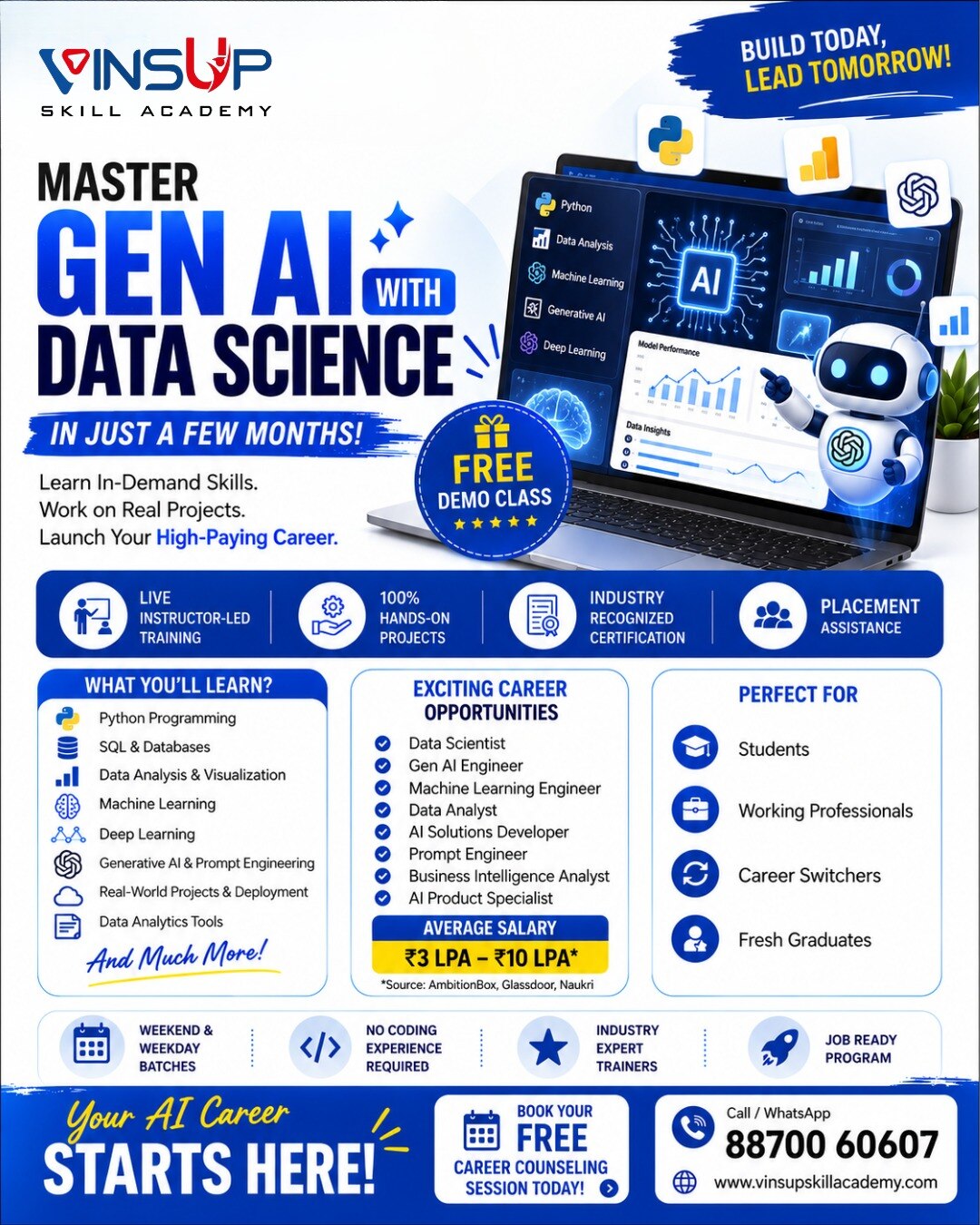
When reviewing a course such as VINSUP SKILL ACADEMY’s, ask whether projects expose trade-offs: a cheaper model with slower responses, a more accurate model with higher latency, or a citation failure that blocks deployment.
A course deserves stronger credit when learners can explain when not to use the system, reproduce results from a clean environment, and improve it from recorded evaluation evidence.
Related product
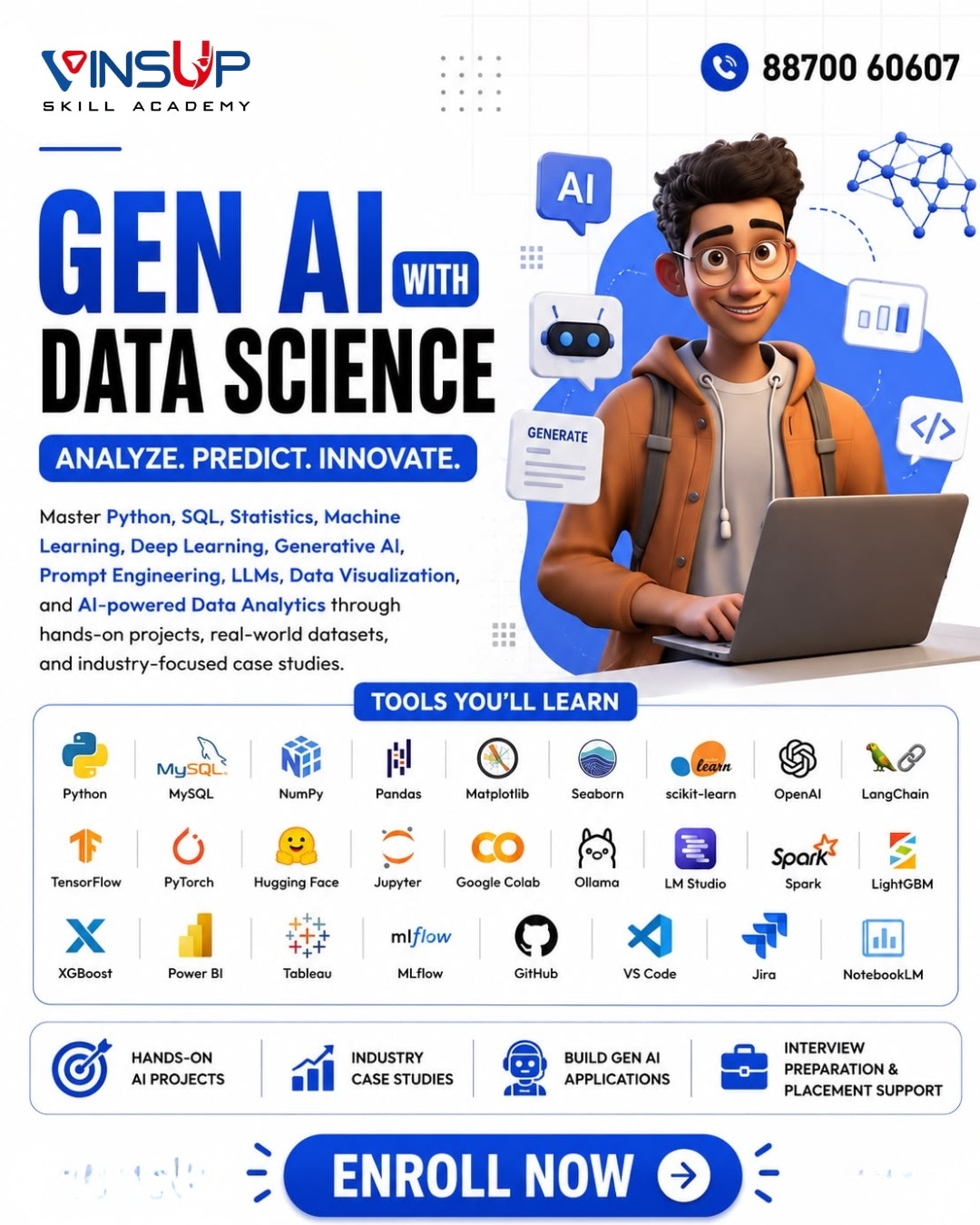 | GEN AI with Data Science Course GEN AI with Data Science Course The course is typically structured around the major pillars of Generative AI and Data Science: 1. View product → |
Frequently asked questions
Which AI careers can a generative AI and data science course realistically prepare you for?
It can support entry-level paths such as junior data analyst, machine learning associate, AI application developer, prompt engineer, and automation developer when your projects demonstrate the required coding and production skills.
What technical stack turns AI knowledge into employable ability?
Focus on Python, SQL, Git, REST APIs, notebooks, pandas, scikit-learn, a deep-learning framework, vector databases, model APIs, testing, and one cloud platform.
How do learners build reliable generative AI applications?
Use controlled prompts, retrieval-augmented generation, source citations, structured outputs, evaluation datasets, error handling, access controls, logging, and tests for hallucinations and prompt injection.
What data science and mathematics make AI systems trustworthy?
Study probability, statistics, linear algebra, optimisation, sampling, correlation, regression, classification metrics, confidence intervals, bias, leakage, and data-quality checks.
What should a job-ready AI portfolio prove?
Show a working application, clean repository, documented data pipeline, evaluation results, baseline comparison, deployment method, cost and latency measurements, and a clear explanation of trade-offs.