Coimbatore
08048034727
+918925876525
UIUX And Graphic Design Course by VINSUP SKILL ACADEMY

UIUX And Graphic Design Course

Phone Number

08048034727

Please keep 0 before dialling the number.

Email Address hrvinsup@gmail.com

Mon-Thu: 10 AM - 2 PM • Fri: 3 PM - 7AM

Other Website Visit our other website
Address A,B, gopalsamy, 148, Gopalasamy Koil St, Sridevi Nagar, Ganapathy, Coimbatore, Tamil Nadu 641006

Coimbatore, India, 641006
Description

A comprehensive program is typically divided into three core pillars: 1. Graphic Design Foundations (The Visuals) Before designing complex app screens, you master the rules of visual communication. Key Topics: Typography, color theory, grid systems, layout composition, and branding/logo design. Industry Tools: Adobe Photoshop (photo editing), Adobe Illustrator (vector graphics), and Adobe InDesign (publishing). 2. User Interface (UI) Design (The Look) UI is all about the actual digital screens a user interacts with. You learn how to make interfaces that are both aesthetically pleasing and easy to navigate. Key Topics: Visual hierarchy, component design (buttons, menus, forms), responsive design (making things look good on both mobile and desktop), and design systems. Industry Tools: Figma (the reigning industry standard) or Adobe XD. 3. User Experience (UX) Design (The Feel & Logic) UX is the analytical side. It answers the question: How do we make this product intuitive and painless for the user? Key Topics: User Research: Interviewing users and creating personas. Information Architecture: Mapping out how a website or app is structured. Wireframing & Prototyping: Sketching low-fidelity blueprints and creating clickable, interactive digital models to test concepts. Usability Testing: Watching real users interact with your prototype to find and fix flaws. Skills You Will Gain Design Thinking: A structured framework for understanding user problems and iterating creative solutions. Prototyping: The ability to build live, clickable previews of applications without writing a single line of code. Empathy & Research: Learning how to put your personal preferences aside to design for the actual target audience. Potential Career Paths Design skills are highly sought after by tech companies, creative agencies, and startups alike: UI/UX Designer: A versatile role handling both the look and layout of digital products. Graphic Designer: Focuses on marketing materials, brand identity, social media assets, and print media. Product Designer: A high-level role that looks at the overall strategy, business goals, and user experience of a product. UX Researcher: Specializes strictly in gathering user data, conducting interviews, and testing prototypes.

Other COURSES

view all

69a92e71c96d5a2824dbd83b Card 2

product image
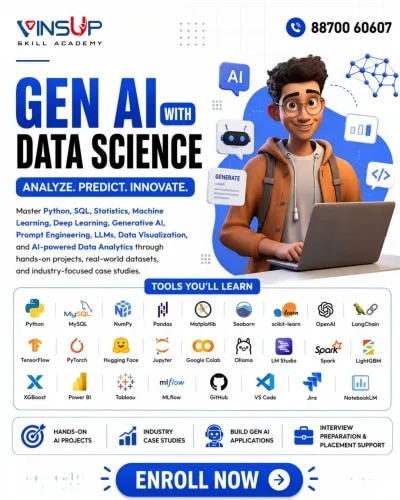
GEN AI with Data Science Course

The course is typically structured around the major pillars of Generative AI and Data Science: 1. Python Programming & Data Analysis Build a strong foundation in Python programming and learn how to collect, clean, process, and analyze data using industry-standard libraries. Gain hands-on experience with real-world datasets and data manipulation techniques. Key Topics: Python, NumPy, Pandas, Jupyter Notebook, Google Colab, Data Cleaning, Data Wrangling, and Exploratory Data Analysis (EDA). 2. Database Management & Data Visualization Learn to retrieve, manage, and visualize data using SQL and powerful Business Intelligence tools. Transform raw data into meaningful insights through interactive dashboards and visual reports. Key Topics: MySQL, SQL Queries, Power BI, Tableau, Matplotlib, Seaborn, Data Visualization, Dashboard Development, and Business Reporting. 3. Machine Learning & Predictive Analytics Understand machine learning algorithms and build predictive models using industry-leading frameworks. Learn how to evaluate model performance and solve real-world business problems through data-driven decision-making. Key Topics: Scikit-learn, XGBoost, LightGBM, Regression, Classification, Clustering, Model Evaluation, Feature Engineering, and Predictive Analytics. 4. Deep Learning & Generative AI Master Deep Learning concepts and build Generative AI applications using Large Language Models (LLMs). Learn Prompt Engineering, AI model integration, and AI application development using modern frameworks. Key Topics: TensorFlow, PyTorch, Hugging Face, OpenAI API, LangChain, Ollama, LM Studio, Prompt Engineering, LLMs, AI Agents, and Generative AI Applications. 5. AI Deployment, MLOps & Industry Projects Learn to deploy AI and Machine Learning models, track experiments, collaborate using GitHub, and work on real-world industry projects. Gain practical experience with AI workflows from development to production. Key Topics: MLflow, Apache Spark, GitHub, VS Code, Jira, NotebookLM, Model Deployment, MLOps, AI Project Development, and Industry Case Studies. Skills You Will Gain Python Programming, SQL, Data Analysis, Data Visualization, Statistics, Machine Learning, Deep Learning, Generative AI, Prompt Engineering, Large Language Models (LLMs), OpenAI API Integration, LangChain, AI Application Development, MLOps, Power BI, Tableau, Predictive Analytics, Real-World AI Projects, and Industry Case Studies. Potential Career Paths Data Analyst, Data Scientist, AI Engineer, Machine Learning Engineer, Generative AI Engineer, Prompt Engineer, Business Intelligence Analyst, AI Application Developer, NLP Engineer, MLOps Engineer, Research Analyst, and AI Solutions Architect.

69a92e71c96d5a2824dbd83b Card 2

product image
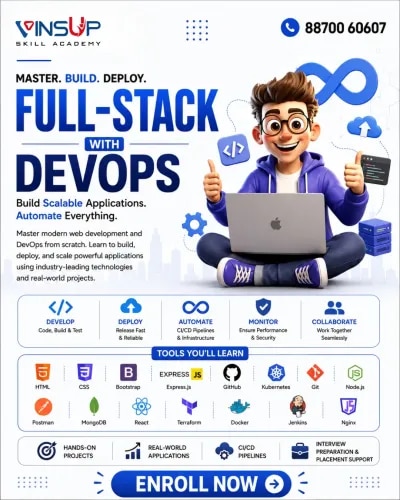
Fullstack with DevOps Course

The course is typically structured around the major pillars of modern software development and DevOps: 1. Front-End Development Learn how to build responsive and interactive web applications using HTML5, CSS3, Bootstrap, JavaScript, and React.js. Key Topics: Responsive design, components, state management, routing, and UI development. 2. Back-End Development Build powerful server-side applications using Node.js, Express.js, and MongoDB. Learn REST API development, authentication, and database management. Key Topics: CRUD operations, JWT authentication, API integration, and database design. 3. Version Control & Collaboration Master Git and GitHub to manage source code, collaborate with teams, and maintain version history. Key Topics: Branching, merging, pull requests, conflict resolution, and repository management. 4. DevOps & Cloud Deployment Learn to automate application deployment and infrastructure using Docker, Kubernetes, Jenkins, Terraform, and Nginx. Build CI/CD pipelines for faster software delivery. Key Topics: Containerization, orchestration, cloud deployment, Infrastructure as Code (IaC), and continuous integration. 5. API Testing & Monitoring Understand API testing using Postman and monitor application performance to ensure reliability and security. Key Topics: API testing, debugging, logging, monitoring, and performance optimization. Skills You Will Gain Full Stack Web Development, MERN Stack Development, DevOps Practices, Cloud Deployment, CI/CD Pipeline Implementation, Docker & Kubernetes, Git & GitHub, REST API Development, Infrastructure Automation, and Real-World Project Development. Potential Career Paths Full Stack Developer, MERN Stack Developer, DevOps Engineer, Cloud Engineer, Software Engineer, Backend Developer, Front-End Developer, Site Reliability Engineer (SRE), Application Developer, and Technical Support Engineer.

69a92e71c96d5a2824dbd83b Card 2

product image
Digital Marketing Course

The course is typically structured around the major pillars of the digital ecosystem: 1. Search Engine Optimization (SEO) Learning how to get a website to rank on the first page of Google organically (without paying for ads). Key Topics: Keyword research, on-page optimization (headings, meta descriptions), technical SEO (site speed, mobile-friendliness), and link building. Why it matters: High search rankings bring free, consistent traffic to a business. 2. Search Engine Marketing (SEM) & Paid Search Mastering paid advertising platforms to drive immediate traffic and sales. Key Platforms: Google Ads. Key Topics: Pay-Per-Click (PPC) campaigns, bidding strategies, ad copy creation, and Quality Score optimization. 3. Social Media Marketing & Ads (SMM) Understanding how to build an organic community and run paid ad campaigns on social platforms. Key Platforms: Meta (Facebook & Instagram), LinkedIn, TikTok, and YouTube. Key Topics: Content strategy, audience targeting, pixel tracking, and measuring ad spend return (ROAS) 4. Email & Content Marketing Nurturing leads and building long-term customer loyalty through valuable content. Key Topics: Copywriting, blogging, creating lead magnets, setting up automated email workflows, and audience segmentation. 5. Web Analytics & Data Tracking Digital marketing is nothing without data. This phase teaches you how to measure if your campaigns are actually working. Key Tools: Google Analytics 4 (GA4), Google Tag Manager. Key Topics: Tracking conversions, analyzing user behavior, calculating acquisition costs (CPA), and building marketing dashboards. Skills You Will Gain Campaign Strategy: Learning how to map out a marketing funnel (Awareness $rightarrow$ Consideration $rightarrow$ Conversion).Data-Driven Decision Making: Reading metrics and charts to understand exactly where a company is gaining or losing money.A/B Testing: Experimenting with different headlines, images, or audiences to find the highest-performing combination. Potential Career Paths Digital marketing skills are essential for startups, major corporations, and creative agencies alike: Digital Marketing Specialist: A versatile role managing multiple online channels (SEO, social, email). SEO Specialist / Strategist: Focuses purely on improving organic search rankings and web traffic. Performance Marketing / Paid Media Specialist: Manages advertising budgets and optimizes paid ad campaigns to drive direct ROI. Content Marketer / Social Media Manager: Focuses on brand voice, storytelling, and community engagement.