
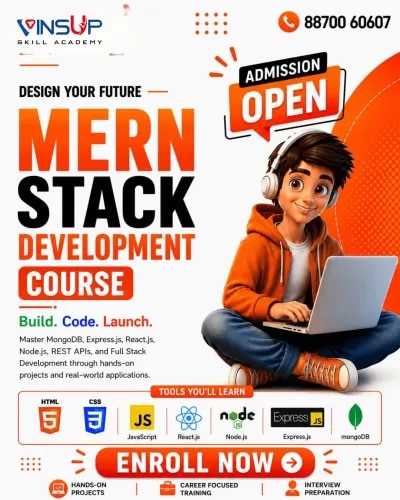
Most comprehensive MERN stack programs guide you through three major phases: 1. Frontend Development (The Client Side) Before diving into MERN, you will master the basics of how web pages look and behave. Foundations: HTML5, CSS3, and modern JavaScript (ES6+). React Mastery: Components, state management (Hooks like useState, useEffect), routing, and managing global data using tools like the Context API or Redux. 2. Backend Development & Databases (The Server Side) This is where you build the “brains” of the application. Server Setup: Writing server-side code with Node.js and routing requests with Express.js. API Development: Creating RESTful APIs so your frontend can securely request or send data to the backend. Database Management: Connecting to MongoDB, creating data schemas using Mongoose, and performing CRUD operations (Create, Read, Update, Delete). 3. Advanced Integration & Deployment The final phase brings everything together into a live, functioning product. Authentication: Securing your app with user login, registration, password hashing (bcrypt), and JSON Web Tokens (JWT). Deployment: Deploying the frontend (on platforms like Vercel or Netlify) and the backend/database (on Render, AWS, or MongoDB Atlas) so anyone on the internet can use your app. Why Choose a MERN Stack Course? One Language for Everything: You only need to master JavaScript to write code for both the browser and the server, making the learning curve much smoother than switching between languages like Python, PHP, or Java. High Demand: MERN is incredibly popular among startups and tech companies because it allows for rapid development and high performance. Project-Based Learning: Almost all MERN courses are highly practical. You will typically graduate with real-world portfolio projects like an e-commerce platform, a social media clone, or a project management tool.
Address
A,B, gopalsamy, 148, Gopalasamy Koil St, Sridevi Nagar, Ganapathy, Coimbatore, Tamil Nadu 641006
Coimbatore, India, 641006